
Optimizing Weapon Detection: The Role of Human-Reviewed Synthetic Datasets
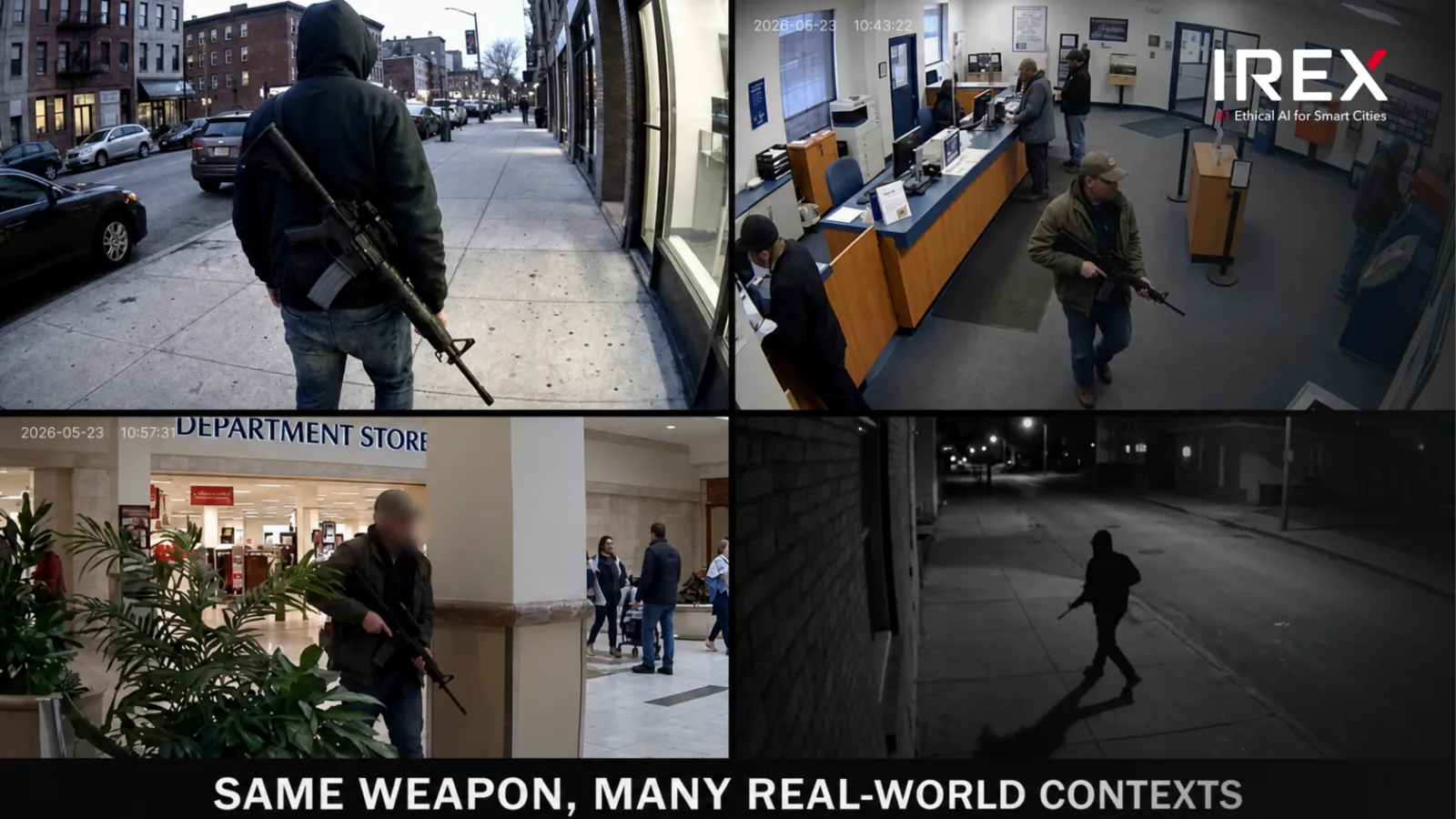
AI-powered weapon detection relies on massive training datasets. Real-life footage, however, is limited, sensitive, and often problematic. Building an AI that detects weapons…
23 July, 2026 [Alexandria, VA]
AI-powered weapon detection relies on massive training datasets. Real-life footage, however, is limited, sensitive, and often problematic. Building an AI that detects weapons accurately requires a classifier that distinguishes between weapon types, and the methods for building that classifier vary across development teams.
IREX addresses this challenge by combining CCTV frames from its own datasets with synthetic, shape-accurate weapon overlays. The process is a precise manual craft, not a push-button solution.
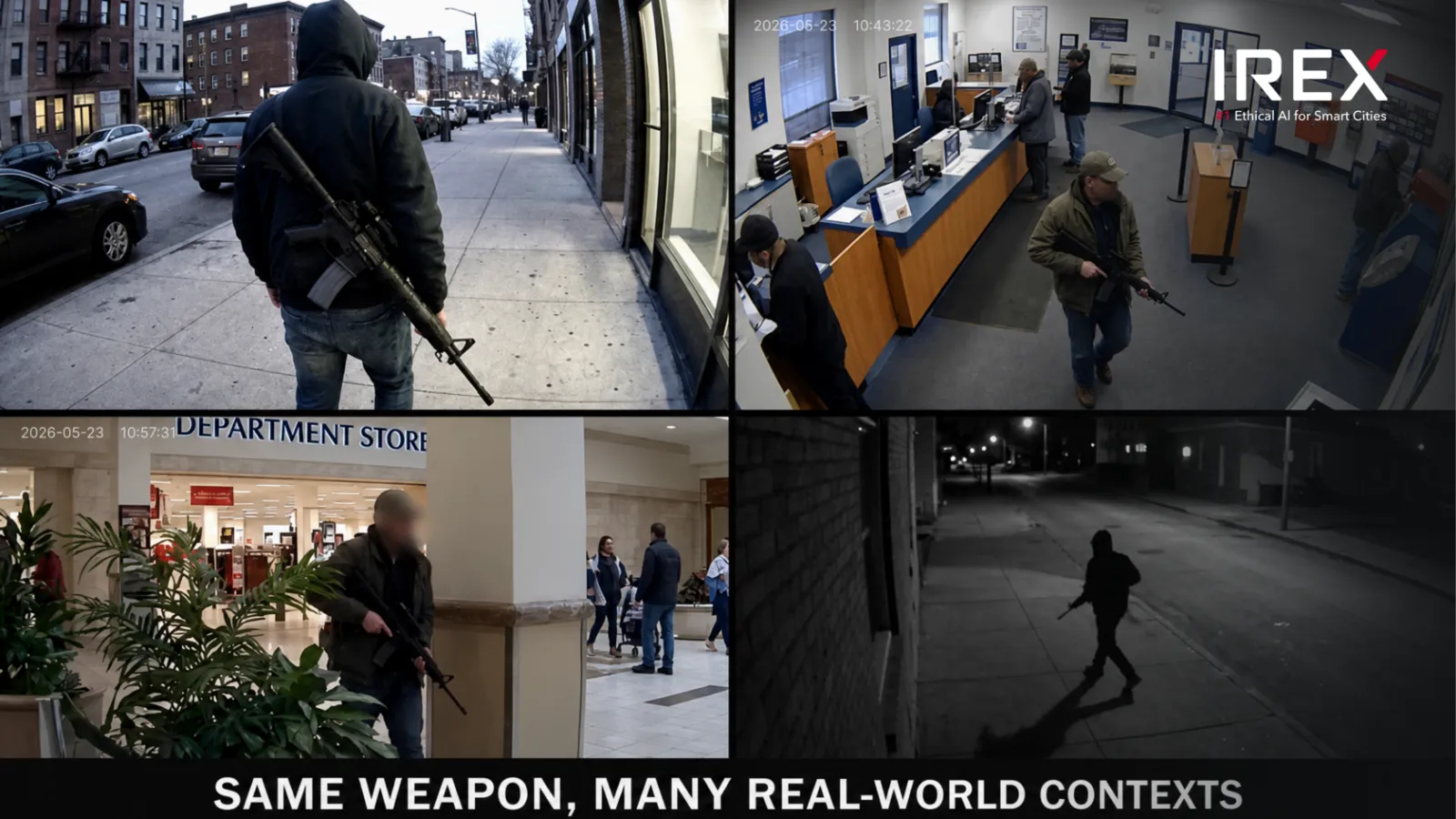
for demo purposes only
Building the reference set
IREX splits firearms into two size-based groups. The small-weapons group covers pistols and revolvers; the large group covers rifles and shotguns. Scale and pixel count determine how the team places, renders, and trains on each weapon. A pistol rendered at 30 pixels requires a different approach than a shoulder-fired shotgun.
For each weapon, IREX uses four clean reference images, standardized to the same resolution and format. These images preserve silhouettes, proportions, and key details, so generated examples retain the weapon’s shape - the primary cue the classifier must learn.
A pre-assembled pack of construction-site and public-space CCTV frames supplies realistic scenes with people, clothing, motion blur, lighting, and compression artifacts. IREX overlays the reference weapons onto these frames, so the model learns to detect firearms in authentic, noisy footage rather than in clean studio renders.
Generation process
The pipeline involves taking a background frame, selecting a reference weapon, compositing the weapon while preserving its shape, randomizing color, finish, and attachments, and placing it with varied angle, scale, and occlusion. In practice, roughly 75% of generated samples are discarded. Of approximately 1,200 attempts per weapon, only about 300 pass manual filtering.
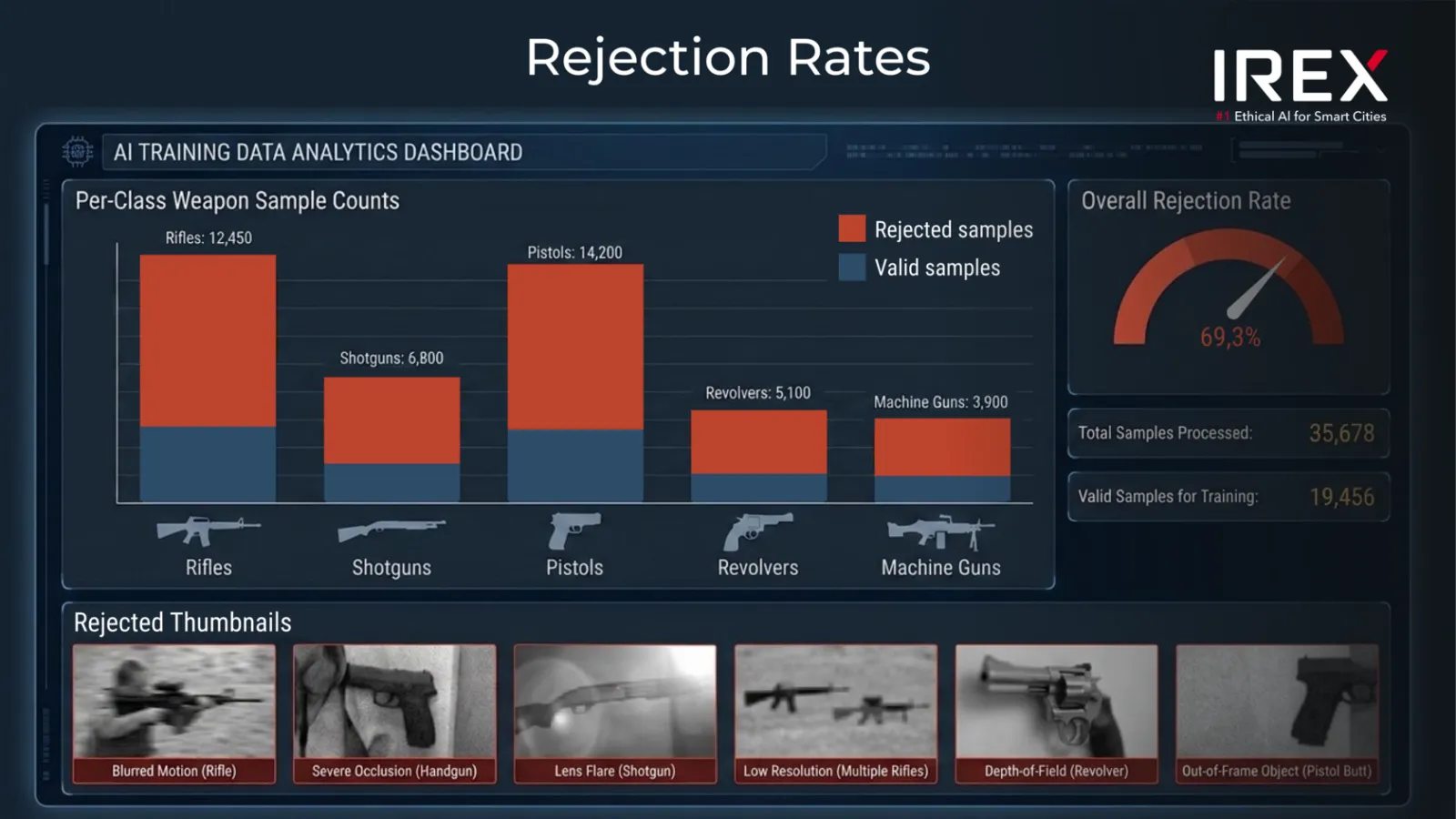
for demo purposes only
Small weapons are the hardest case. On distant subjects they occupy very few pixels, so errors in scaling or placement produce the wrong cues - a visibly oversized pistol, for example. Common defects include compositing artifacts, incorrect scale, exaggerated contrast, blur, highlight clipping, and shape distortion. Large weapons tolerate these errors better; small weapons require painstaking manual review.
Human quality control
Automated checks catch some issues, but human reviewers decide the rest. IREX reviewers confirm that each weapon and its key details match the references, that scale is correct relative to hands and bodies, and that the weapon integrates realistically with scene lighting and shadows. Only verified examples enter neural-network training, producing balanced classes of approximately 300 verified examples per weapon.
IREX pretrains its models on the curated synthetic set, then fine-tunes on any real annotated CCTV available. Evaluation surfaces blind spots: the model may miss tiny pistols in dim light or confuse an umbrella for a weapon. IREX then generates targeted synthetic examples - more low-light pistols, different grips, partial occlusions - and repeats the process. That loop closes gaps faster than sourcing rare real footage.
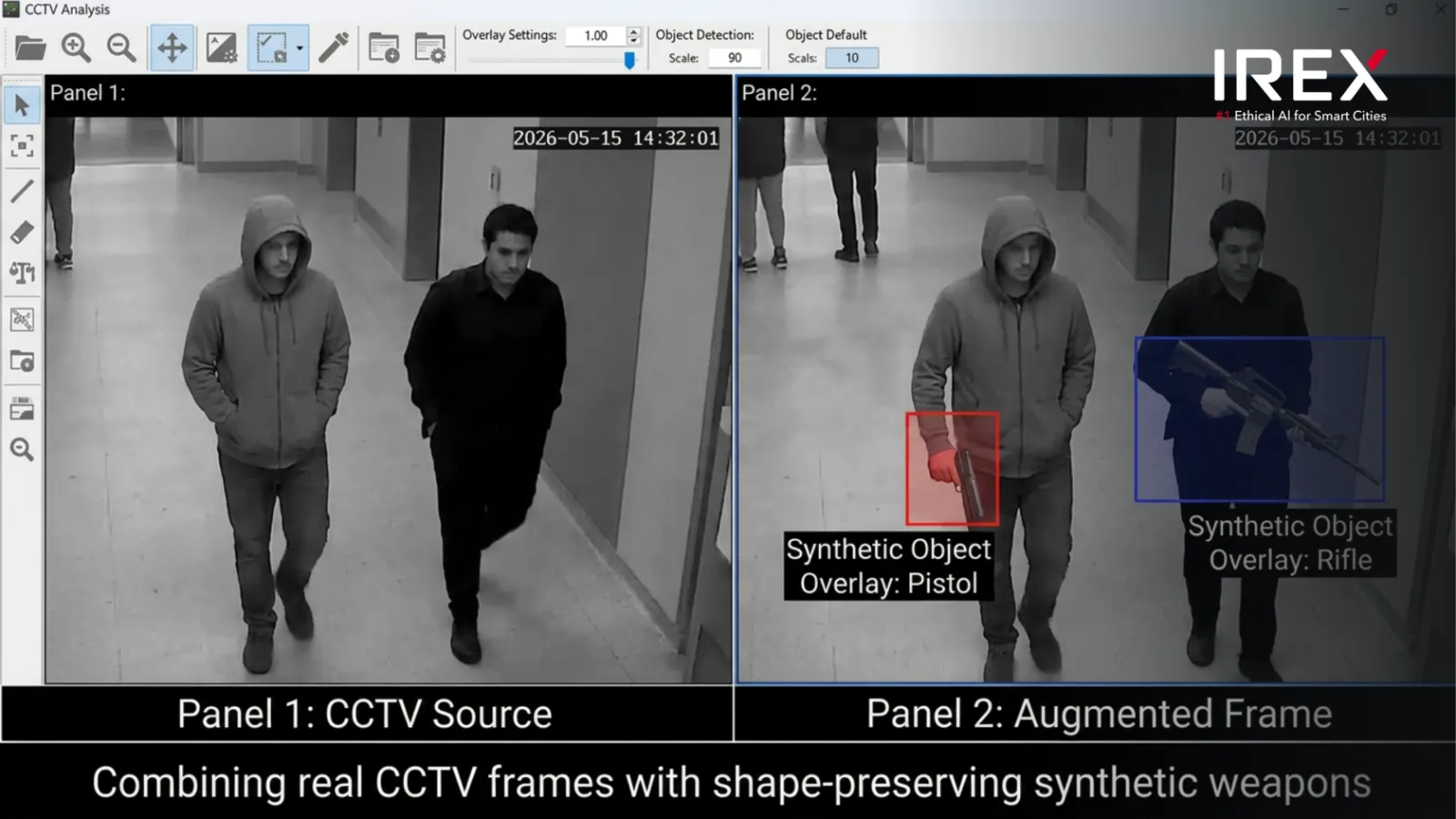
for demo purposes only
Synthetic generation accelerates dataset creation, but it doesn’t remove human judgment. IREX accepts a high rejection rate to build a classifier that performs better in noisy, real-world CCTV conditions. Shape-first generation, human review, and focused iteration are what make the detector truly reliable in the real world.