
A Systematic Approach to Advanced Facial Recognition
Accurate facial recognition remains a cornerstone of modern security infrastructure, but it presents significant technical hurdles that vary by implementation strategy. Several…
July 30, 2026 [Alexandria, VA]
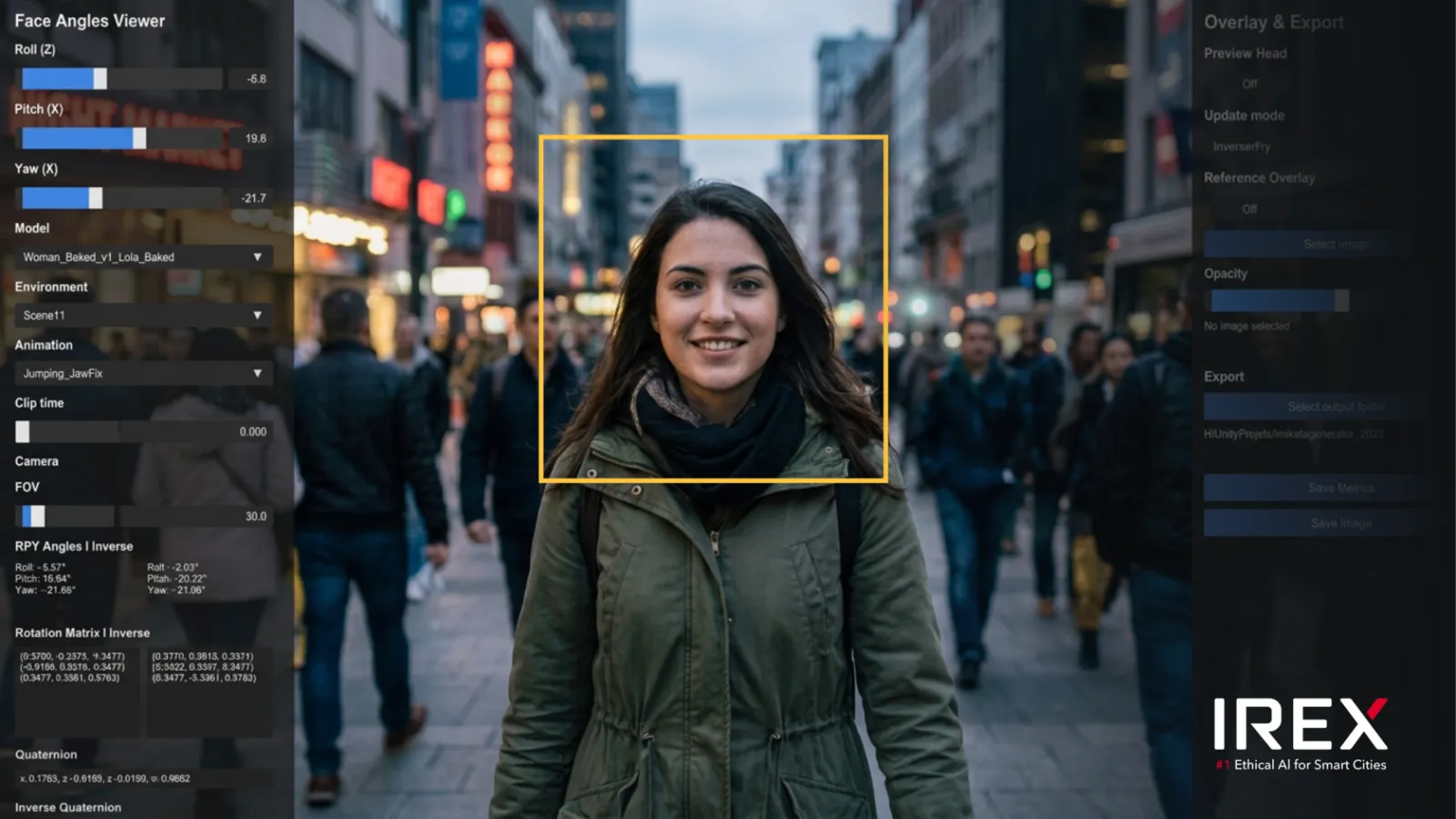
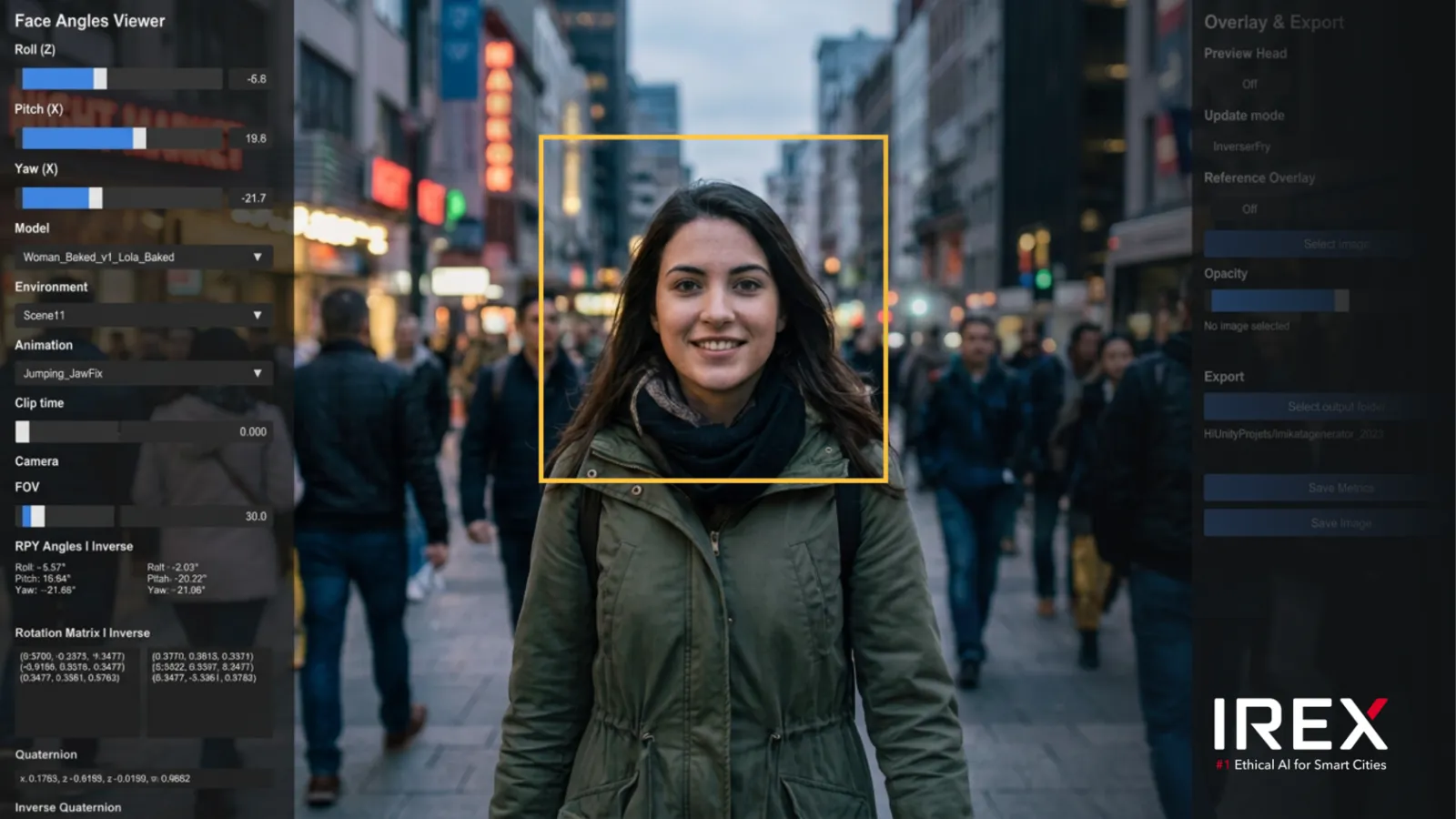
AI-generated picture for demo purposes only
Accurate facial recognition remains a cornerstone of modern security infrastructure, but it presents significant technical hurdles that vary by implementation strategy. Several approaches currently dominate the field, yet real accuracy depends on overcoming the limitations of the classic front-view face position. Traditional techniques struggle with image distortions and varied head angles in complex environments. As demand for seamless identity verification grows, the reliability of modern face recognition depends on data-driven methodology, mathematical models replacing outdated traditional methods.
IREX is enhancing synthetic data generation, using rotation matrices to produce stable, verifiable head-pose representation. The work spans three efforts:
- Synthetic data: using rotation matrices to create stable, verifiable training data.
- Head pose estimation: adopting 6D vectors over Euler angles to better handle diverse head rotations, improve accuracy in CCTV environments, and avoid limitations such as Gimbal lock.
- Detector refinement: applying an attribute-based taxonomy to systematically analyze and correct errors, improving overall recognition accuracy.
Together these initiatives shift IREX toward robust mathematical models and data-driven workflows that analyze performance errors and drive iterative training, specifically addressing edge cases such as non-frontal and off-angle head poses.
Synthetic data generation
IREX is refining synthetic data creation to better support head-pose recognition, moving away from Euler angles (roll-pitch-yaw), which proved difficult to visualize and verify.
The team adopted rotation matrices, which treat the head as a set of basis vectors and provide unambiguous, intuitive validation that is easier to interpret than complex, interdependent angles. A new three-stage generation pipeline, built on a cutting-edge AI model, generates realistic visuals, adds accessories, and translates the images into the CCTV domain. The workflow is producing a high-quality dataset of 30,000 diverse images (3,000 original backgrounds with varied 3D rotations and accessories) currently undergoing automatic validation using face-reconstruction libraries.
Head pose estimation
The precision of head-pose estimation depends heavily on selecting high-quality frames. IREX is moving from Euler angles to 6D vectors, a state-of-the-art alternative that resolves issues like Gimbal lock and periodicity and yields a more scalable, CPU-efficient method with reliable mapping for rotation matrices. Because accurate head-rotation markup is difficult to gather from real subjects, IREX combines auto-labeling and synthetic data for training, reserving manual review for critical edge cases.
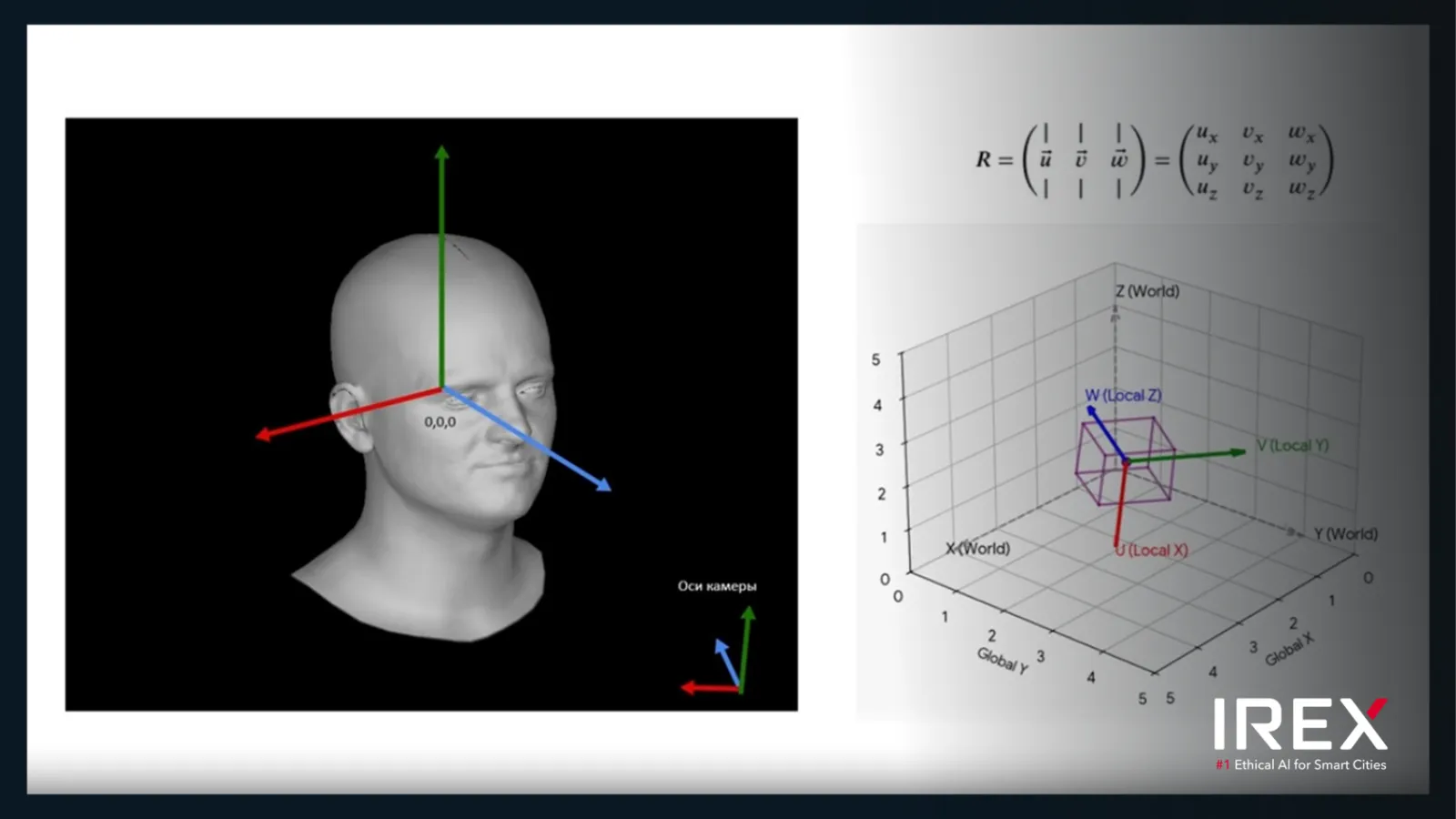
for demo purposes only
Face detector and key points refinement
A lack of diverse head-pose angles is a significant contributor to reduced detection performance. IREX refines its face detector and key-point alignment model through a structured, iterative framework.
Test data is marked up with a bounding box, key points and corresponding attributes. An attribute-based taxonomy classifies and tracks errors across head orientation, occlusions such as sunglasses or hoodies, and camera distortion. Categorizing errors this way enables the team to diagnose recognition failures accurately rather than guess at architectural changes. The taxonomy includes:
- Head pose, accessories, and distortions
- Demographic factors: age group, gender, and ethnicity
- Image source and facial characteristics
- Multi-face scenarios and face occlusions
The workflow centers on data-driven improvement. By evaluating performance across specific sub-datasets, such as profile versus frontal poses, IREX targets and closes gaps in the training data, with additional training and validation using customer-specific data.
IREX is overcoming long-standing facial recognition barriers by strengthening its mathematical foundation and adopting an iterative, data-driven workflow. With advanced tooling and precise data classification, the work goes beyond incremental model tuning to build a significantly stronger, more adaptable system. IREX’s focus remains on closing critical data gaps and validating performance against real-world, customer-specific data to keep the technology accurate and reliable for the most demanding security challenges.